Built for organizations.
Access-first publishing supports public collections, restricted programs, course materials and private institutional knowledge.
Talk to usSecurity
Traditional ebook security focuses on DRM – the downloaded file is bound to the device.
ReaderPub does not deliver any files.
Instead, we protect the book's text from copying.
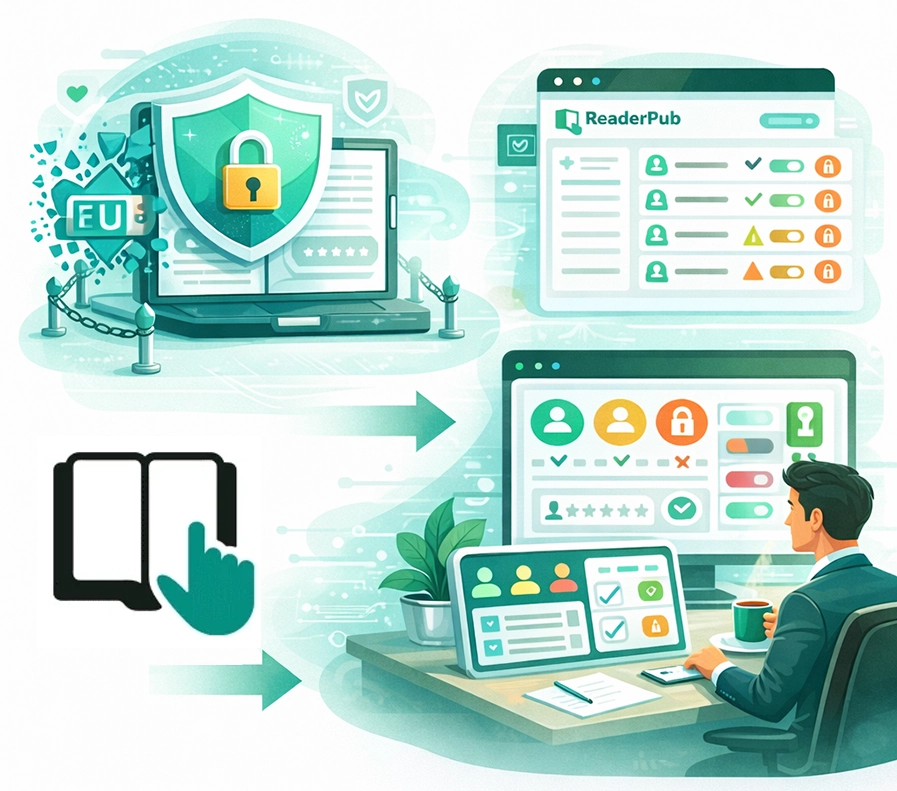
When complete files are distributed to readers, publishers lose much of their control over what happens next.
Once that file exists on a device, it becomes the starting point for extraction, conversion, and redistribution.
A complete ebook file reaches the reader’s device.
The file becomes available for copying outside the original platform.
It can be turned into DRM-free ebook formats for reuse.
Once a reusable file circulates, redistribution can scale quickly.
This pattern is repeatable, automatable, and widely used by book pirates across the industry!
ReaderPub's primary model keeps reading on the web through controlled access rather than routinely delivering a complete downloadable book file to every reader.
ReaderPub offers protected web editions: readers access content in the browser through WeRead instead of receiving a downloadable book file.
All your books are fully protected by the patent-pending WeRead Theft Guard that employs glyph images instead of regular characters, so the text is not accessible to crawling robots.
Designed to reduce copying, downloading, and unauthorized redistribution.
We protect your books against downloading or copying by the patent-pending WeRead Theft Guard.
Open a protected edition and try the reading experience directly.
Mark Twain
Robert Louis Stevenson
Dante Alighieri
Beatrix Potter
Lewis Carroll
Carlo Collodi
ReaderPub gives institutions, publishers and organizations control over access to their publications. You decide who can read, under what conditions and at what level of visibility.
Access-first publishing supports public collections, restricted programs, course materials and private institutional knowledge.
Talk to us
ReaderPub removes the most scalable starting point for large-scale piracy:
we don't deliver a complete, reusable ebook file to the end user.
At that, our web-accessible book editions are fully protected against serial downloading or copying.
ReaderPub security is designed for web-native publications, direct publishing and institutional collections.